Endoscopic spine surgery is one of the most advanced minimally invasive techniques available today to treat disc herniations, lumbar canal stenosis and other spinal conditions. Compared to traditional open surgery, it allows access to the affected area through incisions of just a few millimeters, with magnified visualization of the surgical field and a much smaller impact on the surrounding muscles and tissues.
For many patients, this means less postoperative pain, a shorter recovery and the possibility of returning to normal life sooner. In this guide we explain exactly what it is, in which cases it is indicated and why more and more patients in Valencia choose this option whenever their spinal condition allows it.
What is endoscopic spine surgery?
Endoscopic spine surgery is a minimally invasive surgical technique that uses an endoscope — a thin optical device with its own camera and light — to access the inside of the spinal canal and treat the lesion without opening the back as in classical surgery.
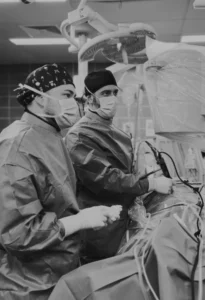
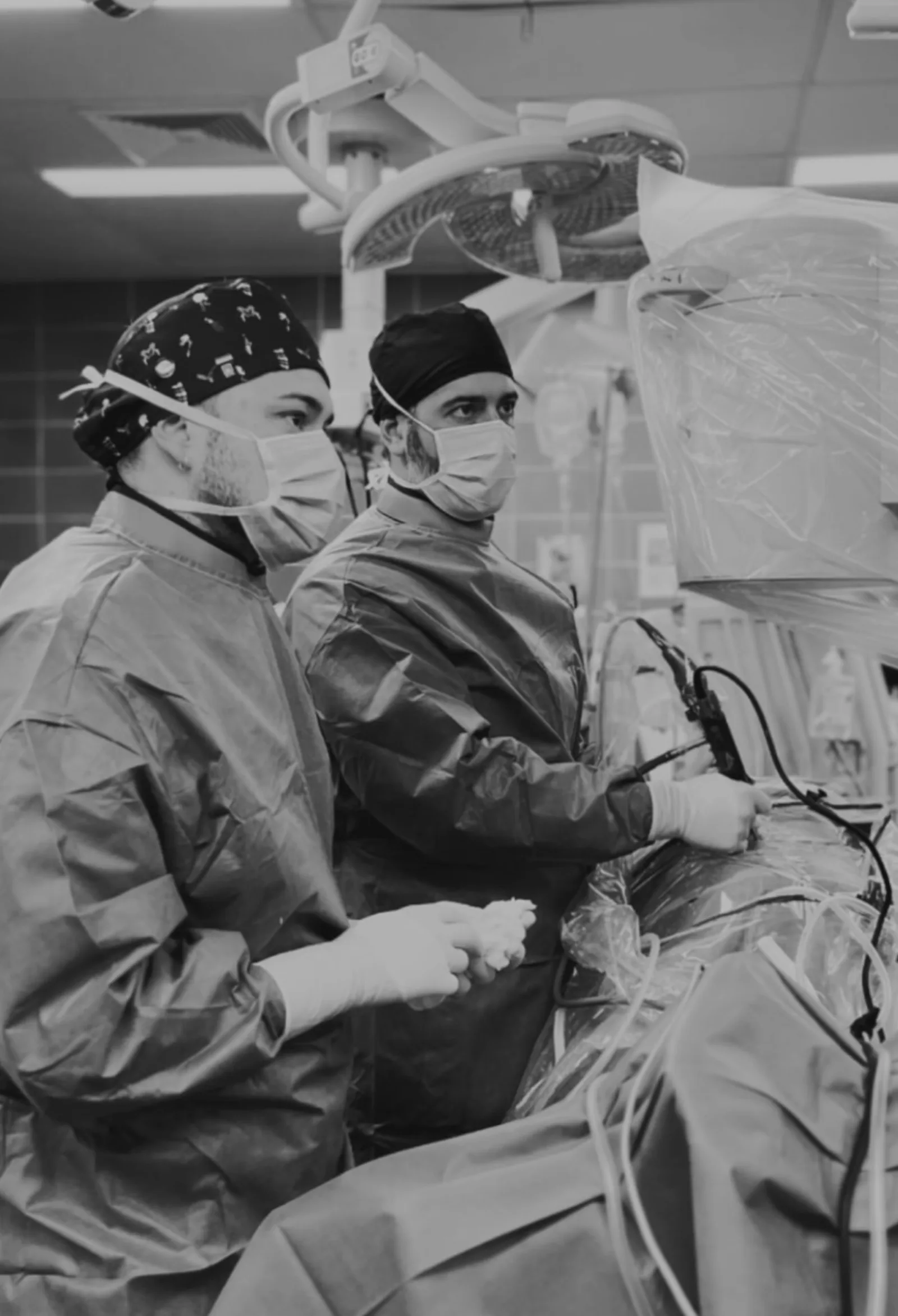
Through one or two incisions of 5 to 10 millimeters, the surgeon introduces the endoscope and the surgical instruments. The magnified image is projected onto a high-definition monitor, allowing work with a level of detail that in many cases exceeds direct vision.
There are two main variants depending on the number of incisions:
- Uniportal endoscopy: a single incision through which both the endoscope and the instruments enter.
- Biportal endoscopy (UBE/ESUBE): two independent incisions, one for the endoscope and another for the instruments. It allows greater freedom of movement and the treatment of more complex pathologies. This is the differential technique we practice at the Mediterranean Spine Institute (ICEM) at Hospital La Salud, Valencia.
How is it different from open surgery?
Open spine surgery — still essential in some situations — requires incisions of several centimeters, dissection of the paravertebral muscles and often removal of part of the bone to access the lesion. The endoscopic technique aims to achieve the same therapeutic goal while preserving healthy structures as much as possible.
| Aspect | Endoscopic surgery | Open surgery |
|---|---|---|
| Incision size | 5–10 mm | 4–10 cm |
| Muscle damage | Minimal | Significant |
| Bleeding | Very low | Moderate–high |
| Postoperative pain | Low | Moderate–high |
| Hospital stay | 0–1 night | 3–5 nights |
| Return to work* | 2–4 weeks | 6–12 weeks |
| Scar | Almost imperceptible | Visible |
*Timelines are approximate and depend on the pathology, type of work and individual patient progress.
When is it indicated?
Endoscopic surgery does not replace diagnosis or clinical judgment: it is one more tool, indicated for properly selected patients. The most common indications are:
- Lumbar disc herniation that does not respond to conservative treatment (medication, physical therapy, infiltrations) after 6–12 weeks, or that causes neurological deficit.
- Lumbar canal stenosis with neurogenic claudication that limits quality of life.
- Selected cervical disc herniation.
- Synovial cysts and other root compressions.
- Recurrences after a previous surgery, in selected cases.
Not all patients are candidates: the decision depends on the exact location of the lesion, individual anatomy, the presence or absence of vertebral instability and overall health. That is why an in-person evaluation with up-to-date imaging is essential.
If you have persistent low back pain, sciatica or functional limitation and want to know if your case is a candidate for endoscopic surgery, you can request an evaluation with Dr. Vilatela at ICEM (Hospital La Salud, Valencia). Book a private appointment →
How is the procedure performed?
The procedure is performed in the operating room, usually under general anesthesia or sedation with local anesthesia, depending on the technique and case. The simplified process is as follows:
- Patient positioning on the surgical table, usually prone (face down).
- Exact level identification using intraoperative radiological control (fluoroscopy).
- Millimetric incision (one or two depending on the technique) through which the endoscope is introduced.
- Access to the spinal canal while preserving the paravertebral musculature.
- Treatment of the lesion: removal of the herniated fragment, nerve decompression, widening of the stenotic canal, etc.
- Closure with one or two stitches or an adhesive strip.
The average duration is between 45 and 90 minutes, depending on the pathology treated.
Recovery and postoperative care
One of the great advantages of endoscopic surgery is the speed of postoperative recovery:
- The same day or the day after, the patient walks and, in most cases, is discharged from hospital.
- During the first 2 weeks, lifting weights, driving and prolonged sitting are avoided.
- Between 2 and 4 weeks guided rehabilitation usually begins, with progressive return to low-demand activities.
- At 2–3 months moderate sports practice is resumed, always under medical guidance.
Postoperative follow-up is carried out at the ICEM clinic at Hospital La Salud and is adjusted to the progress of each patient.
Advantages and limitations of the technique
Advantages:
- Millimetric incisions and minimal scarring.
- Less intraoperative bleeding.
- Significantly less postoperative pain.
- Shorter hospital stay (often outpatient).
- Preservation of musculature and vertebral stability.
- Faster return to work and social life.
Limitations:
- Not all cases are candidates: rigorous selection is required.
- Demanding surgical learning curve: only surgeons with specific training should perform it.
- Some complex pathologies (severe deformities, large instabilities) still require open surgery or additional instrumentation.
That is why it is essential that the evaluation be carried out by a spine surgeon with proven experience in the technique.
Endoscopic spine surgery in Valencia
At the Mediterranean Spine Institute (ICEM), within Hospital La Salud in Valencia, Dr. Antonio Vilatela and Dr. Pablo Jover offer treatment through uniportal and biportal endoscopic surgery (UBE/ESUBE). It is one of the few units in the Valencia region that routinely practices the biportal technique, considered one of the greatest advances in minimally invasive spine surgery.
Each patient receives an individualized evaluation and the therapeutic proposal that best fits their case, including, when possible, non-surgical alternatives such as regenerative medicine.
📞 Book a private appointment · +34 621 35 26 13
💬 Direct WhatsApp · wa.me/34621352613
📍 Hospital La Salud · C/ del Dr. Manuel Candela, 41 · Valencia
Frequently asked questions
Does endoscopic spine surgery hurt?
The immediate postoperative period is usually very tolerable thanks to the minimal muscle damage produced by the technique. Most patients report mild discomfort that can be controlled with oral analgesia during the first few days. It is not comparable to the postoperative pain of open surgery.
How long does it take to return to normal life?
For common pathologies (lumbar disc herniation, selected stenosis), most patients walk on the same day and resume daily activities within 2 weeks. Return to work is usually between 2 and 4 weeks for non-physical jobs, and between 6 and 8 weeks for demanding physical work.
Is endoscopic surgery covered by my health insurance?
At ICEM we work in private practice and we do not see patients through Asisa or Adeslas. If a patient wishes to use other insurance, we recommend checking with their company in advance. The private consultation and surgery option allows for faster diagnosis and significant reduction of waiting lists.
This article is for informational purposes only and does not replace medical judgment. Always consult a specialist to assess your particular case.
See also
Wondering whether endoscopic or open surgery is right for you? Full comparison: endoscopic vs open spine surgery.
See also: Before deciding on any endoscopic surgery, it is worth knowing first whether surgery is necessary at all: When should a herniated disc be operated on? Signs and criteria.
See also: For a complete view of all the minimally invasive techniques we practice: Minimally invasive spine surgery: full overview.
About Dr. Antonio Vilatela
Spine surgeon and co-founder of the Instituto de Columna Mediterráneo (ICEM) at Hospital La Salud, Valencia. Over 10 years of experience in biportal endoscopic spine surgery (UBE/ESUBE), one of the most advanced minimally invasive techniques for treating disc herniations and lumbar canal stenosis. Active member of SECOT, GEER, SOTOCAV and SILACO.
Private practice · Hospital La Salud, C/ del Dr. Manuel Candela, 41, Valencia · Direct WhatsApp · +34 621 35 26 13