Regenerative medicine that uses your own monocytes —the repair cells in your blood— to act on the inflammation behind low back pain and disc degeneration. Individualized assessment in Valencia with Dr. Antonio Vilatela.
Monocyte therapy is a regenerative medicine treatment that uses your blood’s own repair cells —the monocytes— to act on the inflammatory component now known to play a part in disc degeneration and chronic low back pain. It is obtained from a simple blood draw, it is autologous (it comes from your own body) and it is applied on an outpatient basis. It does not replace treatments of proven efficacy when these are indicated, but it opens a biological, minimally invasive avenue within a personalized plan.
Monocytes are white blood cells of the immune system. When a tissue is damaged, they are among the first cells to arrive: they release cytokines and growth factors, organize the clean-up of the injured tissue and orchestrate its repair. Monocyte therapy consists of concentrating those cells from your own blood and returning them, in greater number, to the area we want to treat, to reinforce that repair signal exactly where it is needed.
Unlike other therapies that mainly provide growth factors, here we administer living cells able to regulate the inflammatory environment and to enhance the work of the tissue’s own repair cells.
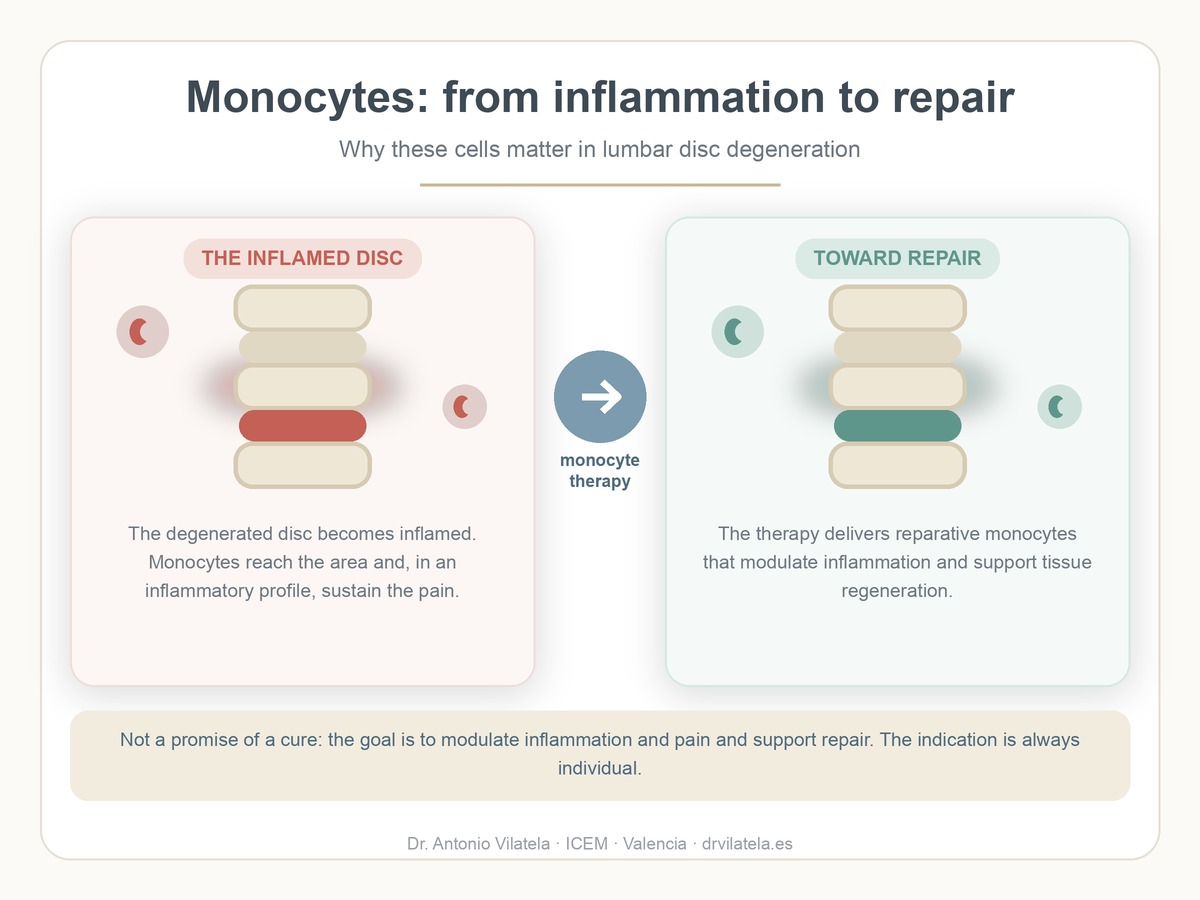
For years, disc degeneration was explained as simple mechanical wear. More recent research shows it is also an inflammatory, immune-mediated process: monocytes and macrophages (the cells monocytes turn into) infiltrate the degenerated disc and play a decisive role in the inflammation that sustains chronic low back pain.
The key is the balance: these cells can adopt an inflammatory profile, which perpetuates the damage, or a reparative profile, which helps to stabilize the tissue. Monocyte therapy aims to tip the balance toward repair. It is a therapeutic target supported by the scientific literature of recent years in the field of disc degeneration.
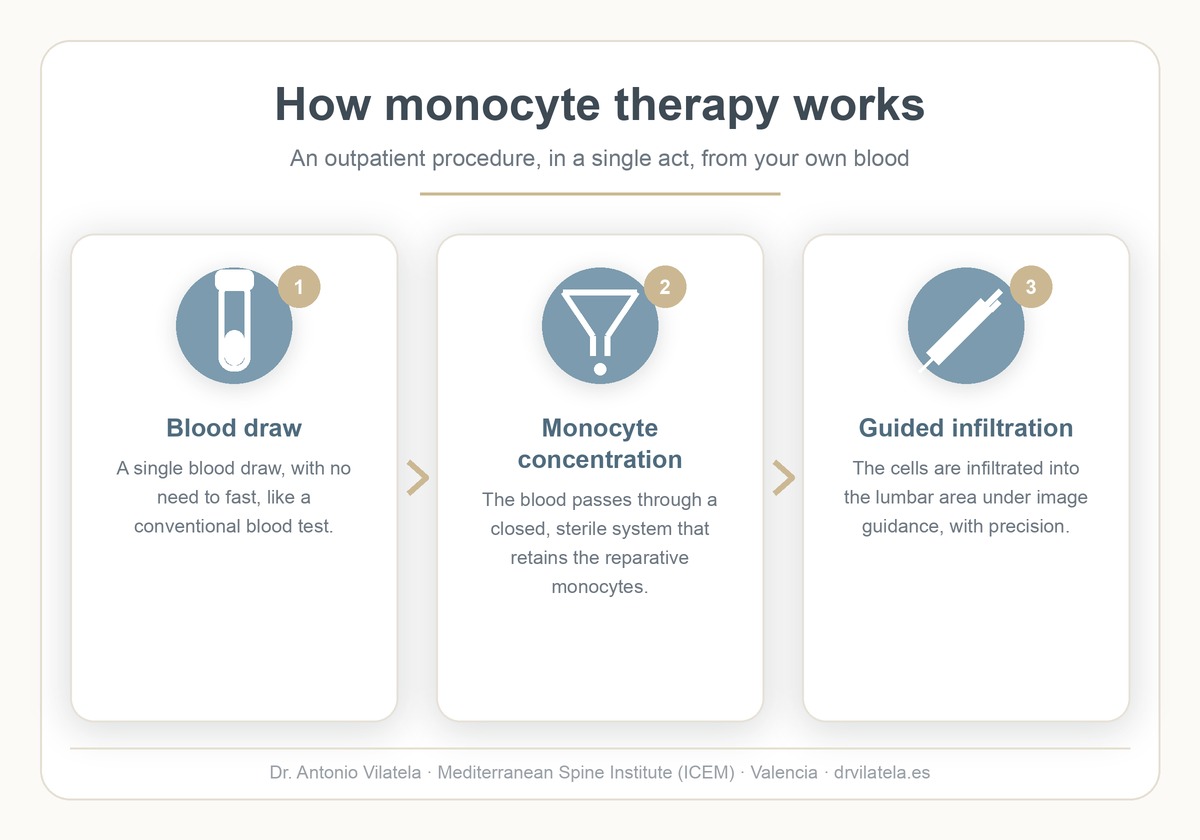
It is an outpatient procedure, in a single act and without admission. These are the steps:
Clinical history, examination and MRI to confirm that your case is a candidate and that the therapy makes sense.
A single blood draw, with no need to fast, like a conventional blood test.
The blood is processed in a closed, sterile system that retains the reparative monocytes and discards the pro-inflammatory fraction.
The cells are infiltrated into the target lumbar area under image control, to place them with precision.
Relative rest for 24 hours and back to normal life. Anti-inflammatories are avoided so as not to blunt the biological effect.
Monocyte therapy is considered, above all, in patients with low back pain of discogenic origin in early or moderate stages, or who are looking for a biological option before considering surgery. It may be considered in situations such as:
Chronic low back pain in which the disc, with its inflammatory component, is the source of the pain.
Worn discs that still retain sufficient height and structure.
Patients who have exhausted conservative care and want a biological avenue before surgery.
People for whom surgery is not indicated or who prefer to avoid it.
Regenerative medicine applied to the spine is a field of active research, and it deserves to be discussed honestly:
This transparency is part of how we work: we prefer to explain what science supports today rather than promise results.
Monocyte therapy sits alongside the other regenerative options for the spine, which can be combined depending on the case:
Platelet-rich plasma mainly provides growth factors; monocytes provide living cells that regulate inflammation and enhance repair.
The liquid disc prosthesis acts on the disc’s mechanics; monocytes act on its biology and inflammation.
In regenerative medicine these techniques do not compete: they are chosen and, at times, combined according to what your spine needs.
With more than 2,500 patients treated, Dr. Antonio Vilatela approaches low back pain in a stepwise, honest way: first confirm the real source of the pain, then choose the least invasive treatment that can resolve it, and reserve surgery for when it truly adds value. Monocyte therapy is offered as one more tool within his regenerative medicine work, indicated only when it fits your case. If you are travelling to Valencia for treatment, see the information for international patients.
We do not talk about a cure. Its goal is to modulate inflammation, reduce pain and support tissue repair. In many patients it improves symptoms and quality of life, but results vary and are assessed case by case.
It is an outpatient procedure performed under local anaesthesia at the infiltration site. In many cases a single application is enough; if your case needs more, we explain it at the assessment.
As it comes from your own blood, it is an autologous therapy: it does not cause rejection or transmit diseases. It is performed by a specialist after confirming that you are a candidate.
In selected cases it may be an option to consider before operating, but it is not a guarantee: it depends on your diagnosis. When surgery is clearly indicated, monocyte therapy does not replace it.
The biological effect is gradual and usually appears over the following weeks, not immediately. That is why anti-inflammatories are avoided in the first few days.
Consultations are private. We do not work with Asisa or Adeslas; you are seen as a private patient so we can give your case the time and follow-up it needs.
Dr. Antonio Vilatela reviews your case in private consultation in Valencia, confirms the source of your pain and tells you honestly whether monocyte therapy —or another option— is what suits you best.